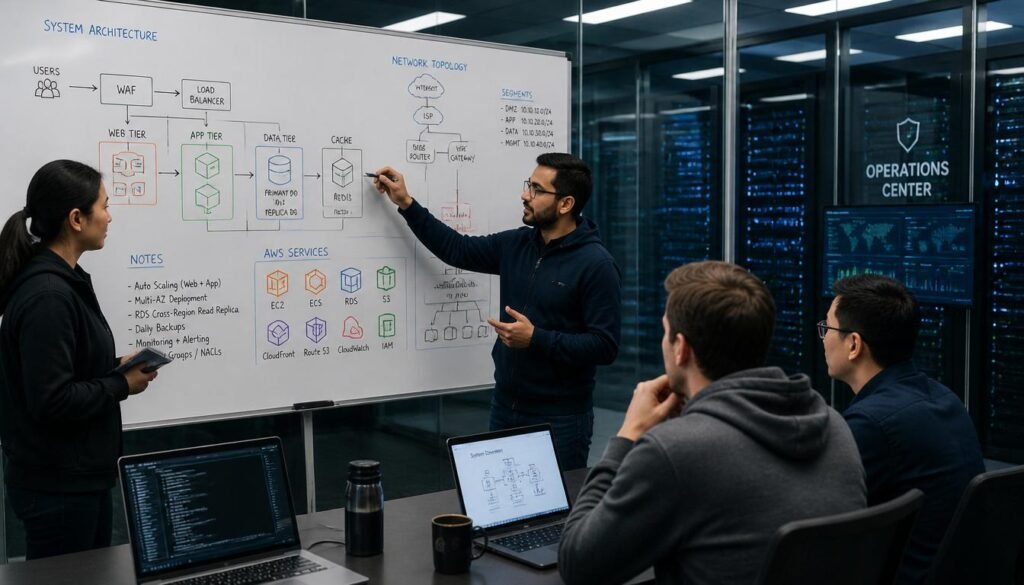
Remote Monitoring and Management (RMM), describes the centralized tools and workflows used to observe, control, and maintain IT assets from afar. For enterprise systems administrators, RMM serves as the operational nervous system: it gathers telemetry, applies policy, automates remediation, and enforces compliance across endpoint fleets, servers, cloud resources, and network devices. Treat RMM like a control room that turns raw device signals into prioritized actions so engineers can focus on strategic problems rather than chasing alerts.
Enterprises in 2026 run mixed estates: on-premises data centers, multiple public clouds, edge locations, Internet of Things devices, and contractor-managed endpoints. That heterogeneity creates scale and security challenges that basic monitoring cannot solve. Modern RMM systems combine agent-based and agentless approaches, API-driven integrations, and policy engines to provide both visibility and direct management controls, which reduces mean time to repair and lowers operational risk.
Procurement choices for RMM now hinge on measurable outcomes: downtime reduction, patch compliance rates, security posture, and cost per managed node. Vendors no longer sell only software; they sell operational patterns and support guarantees. Systems administrators must evaluate RMM through the lens of business continuity, not only technical features, because the right platform directly affects service availability, regulatory compliance, and the speed of incident response.
RMM Platforms for Enterprise Systems Administrators
Enterprise-grade RMM platforms converge on four operational pillars: visibility, control, automation, and security. Visibility means continuous telemetry across machines and services, the data streams that reveal outages or drift. Control means remote command execution, configuration management, and secure file transfer. Automation means standardized playbooks that reduce manual toil. Security means role-based access, least-privilege operations, and cryptographic channel protections. A platform that covers all four pillars reduces reactive firefighting and increases predictable, auditable change.
Platform architectures split broadly between agent-first and API-first models. Agent-first systems deploy lightweight software on endpoints that report telemetry and accept commands, which offers deeper control and offline resiliency. API-first systems integrate cloud-native services and managed endpoints via provider APIs, which reduces deployment friction for cloud resources. In practice, hybrid architectures that combine both approaches give the best trade-off: agents for persistent control on corporate endpoints, and API integrations for cloud and SaaS services where agents cannot run.
Integration ecosystems determine how useful an RMM becomes in everyday operations. Look for native connectors to patch management, identity providers for single sign-on and conditional access, security information and event management systems for consolidated alerts, and IT service management platforms for ticket automation. Operations teams need bidirectional integrations: alerts must create tickets, and ticket status must influence automation. The right integrations turn RMM from a monitoring tool into an operational platform that enforces policy and shortens resolution cycles.
| Platform Category | Strengths | Typical Trade-offs |
|---|---|---|
| Agent-first RMM | Deep endpoint control, offline tasking, granular telemetry | Higher deployment and maintenance effort for agents |
| API-first RMM | Fast cloud resource coverage, lower endpoint footprint | Limited control on unmanaged or air-gapped devices |
| Hybrid RMM | Best coverage across mixed estates, flexible policies | More complex plumbing and vendor coordination |
| Managed RMM Service | Operational staff and SLAs, predictable outcomes | Higher recurring cost, less internal control |
Selecting Top RMM Tools: Security, Scale, Support
Security in RMM requires treating the management channel as a high-value target. Encrypt management traffic end to end, and use mutual authentication so both controller and agent verify each other, similar to how a bank verifies both teller and vault. Implement role-based access control, and enforce just-in-time elevation for sensitive operations so administrators gain higher privileges only for the time needed. Audit trails must be immutable and searchable so compliance teams can prove who did what and when.
Scale considerations are not only node counts. Scale also includes alert volume, automation throughput, and cross-region latency. Design for predictable growth by testing patch jobs and remediation playbooks on representative segments before enterprise-wide runs. Use rate controls and staggered rollouts to avoid overloading networks or update servers. Consider regional failover for the management plane, so a control-plane outage in one cloud region does not blind operations globally.
Support and operational maturity determine whether a platform succeeds post-deployment. Vendor SLAs must cover both software availability and escalation paths to engineering resources. Evaluate professional services offerings and the availability of runbooks, prebuilt playbooks, and community-tested automation templates. Operational playbooks must map to business hours and on-call rotations, so the RMM contributes to service-level agreement targets and measurable incident response improvements.
Introducing the OSCAR Model for RMM evaluation. OSCAR stands for Observability, Scale, Compliance, Automation, and Resilience. Observability covers telemetry depth and customizable dashboards. Scale covers throughput, regional redundancy, and cost predictability as node counts rise. Compliance covers logging, audit retention, and certifiable controls. Automation covers idempotent playbooks and rollback mechanisms, like safe transaction patterns in databases. Resilience covers self-healing capabilities and failover of the management plane. Use OSCAR as a checklist during vendor demos to convert marketing claims into testable acceptance criteria.
Vendor choice examples mapped to OSCAR help. One vendor may excel at Observability and Automation but require extra work for Compliance and Resilience. Another may offer strong Compliance and Scale out of the box at higher cost. Translate each OSCAR dimension into pass/fail criteria tied to business impact: reduce mean time to repair by X minutes, achieve Y percent patch compliance in Z days, or restore control-plane functionality within S minutes during a regional outage.
Operational architecture trade-offs show up in licensing and deployment models. Per-node licensing scales predictably but can penalize dynamic, ephemeral environments. Subscription bundles with telemetry caps may introduce hidden costs when sampling rates rise. Prefer pricing tied to actual business impact, such as critical-service nodes or per-application cost buckets, so finance can forecast expense as architecture changes. Plan license governance up front to avoid surprise bills during incident response when many nodes require elevated monitoring.
Practical Deployment Patterns and Governance
Start deployments with an operational pilot that mirrors production constraints, not a sandbox. A pilot must include real user devices, cloud instances, and at least one air-gapped or contractor-managed endpoint if those exist in production. Use the pilot to validate OSCAR dimensions under real load and to refine rollback procedures. Successful pilots reduce deployment risk and provide empirical data for executive decision-making.
Configuration management within RMM should follow the principle of immutable change where feasible: treat configurations as code. Store playbooks, policies, and agent configurations in version control so changes track like software. This approach makes audits straightforward and enables automated testing of policies before they reach production, similar to how software CI/CD pipelines prevent breaking changes from reaching customers.
Governance requires a policy lifecycle: define, approve, enforce, measure, and retire. Define policies in plain language tied to regulatory or business needs, for example, “All endpoints must apply critical security patches within 72 hours.” Approvals should involve security and business owners, not just IT. Enforcement must include measurable remediation with SLAs, and metrics must feed into executive dashboards to show operational compliance and risk reduction.
Return on Investment and Operational Metrics
Measure RMM success with a short list of high-signal metrics. Track mean time to detect, mean time to repair, percentage of devices compliant with critical patches, automation coverage (percent of incidents handled by playbooks), and total cost of operations per managed node. Use absolute numbers and trends to show where automation frees staff time for strategic projects, such as migrations or new service rollouts.
Calculate financial ROI by mapping reduced downtime to business revenue protection and by valuing reduced manual labor hours. For example, if average incident resolution drops by 30 minutes and incidents number N per month, multiply saved hours by average engineer cost to quantify staffing efficiency. Add avoided outage costs from historical incident data to justify platform investment to finance teams.
Avoid metric inflation by focusing on outcome metrics, not vanity numbers like raw alert counts. High alert volumes may indicate better visibility, but only actions and resolved incidents reflect real operational improvement. Tie RMM metrics to service-level objectives and business KPIs so the platform demonstrates direct, auditable value to non-technical stakeholders.
Frequently Asked Questions
How should an enterprise balance agent-based control versus agentless coverage?
Agent-based control gives deep remediation and offline capabilities because agents can store commands when devices go offline. Agentless coverage reduces deployment overhead by using APIs or network protocols for devices where agents cannot run. Balance by using agents on corporate-controlled endpoints and APIs for cloud/SaaS resources, then use a unified policy layer to provide consistent enforcement across both.
What are the primary security risks introduced by an RMM platform and how do you mitigate them?
The primary risks are credential compromise and misuse of the management channel. Mitigate by using mutual TLS or certificate-based authentication, enforcing least-privilege roles with just-in-time elevation, and implementing immutable audit logs. Isolate the management plane in separate networks and require multi-factor authentication tied to identity providers to reduce unauthorized access.
How should enterprises size RMM automation to avoid surprise network or service impacts?
Test automation at scale during non-peak windows using representative segments. Implement rate limits and staggered rollouts, and use canary deployments similar to application releases to detect cascading failures early. Maintain rollback playbooks and monitor network and service metrics during runs to prevent overload.
Can RMM platforms meet strict regulatory requirements like PCI or HIPAA?
Yes, but only if the platform provides required controls: encrypted transport, role-based access, audit trails with retention policies, and documented change histories. Validate vendor attestations and consider contract clauses for data residency and breach notifications. Perform independent penetration testing on the management plane before production use.
What vendor support models deliver the best operational outcomes for large estates?
A hybrid model combining vendor engineering escalation and dedicated professional services produces the best outcomes. Professional services accelerate initial design and pilot execution, while a vendor engineering tier provides deep troubleshooting during incidents. Combine that with a strong knowledge base and community templates to reduce time-to-value for new playbooks.
Conclusion: Remote Monitoring and Management (RMM): Top Platforms for Enterprise Systems Administrators
RMM platforms act as the operational backbone that keeps enterprise services reliable, secure, and auditable. Evaluate platforms with the OSCAR Model: Observability, Scale, Compliance, Automation, and Resilience. Translate OSCAR dimensions into measurable acceptance criteria that matter to the business, not only to IT teams. Prioritize hybrid architectures that mix agents and API integrations to cover diverse estates without sacrificing control.
Operational success depends on realistic pilots, policy-as-code governance, and integration into ticketing and identity systems. Measure impact with outcome metrics: mean time to detect, mean time to repair, patch compliance, automation coverage, and cost per node. Vendor choice must consider licensing models, professional services availability, and resilience of the management plane to avoid operational surprises during incidents.
Technical forecast for the next 12 months: Expect tighter integration between RMM and cloud-native control planes, with vendors offering more managed playbooks for common enterprise tasks. Identity-driven access will become the de facto standard for RMM authorization, replacing static credentials. Automation will shift from linear scripts to state-aware reconciliation engines that treat configuration as desired state, reducing remediation churn and improving compliance metrics across hybrid estates.
Tags: RMM, enterprise IT, systems administration, observability, automation, IT governance, security